
Everyone Knows the Same IT Skills. What Makes You Different? | Koding Tree
When everyone learns the same IT skills, practical experience, projects, problem-solving and communication can make a difference. Learn how to become job-ready with Koding Tree. Java. Python. Software Testing. SQL. Automation. Data Analytics. These are some of the skills that appear again and again on IT resumes. Now imagine a room filled with 100 candidates. Almost everyone has completed a Java or Python course. Many have certificates. Several have built similar projects. Most can list the same technologies on their resumes. So, what actually differentiates them? The answer isn’t always another programming language. As technology becomes more accessible and learning resources become easier to find, simply knowing a technology is becoming less distinctive. What matters increasingly is how well you can apply what you know, solve problems, communicate your thinking, and demonstrate practical ability. This is where the difference between learning a skill and becoming job-ready begins. When Everyone Has the Same Skills A few years ago, learning a programming language could feel like a major advantage. Today, a student can learn Java, Python, testing tools, SQL, or other technologies through courses, tutorials, bootcamps, documentation, and online platforms. That creates an interesting situation. The technology itself is no longer the entire differentiator. If 1,000 candidates know Java, simply writing “Java” on your resume doesn’t tell an employer much about how you use it. Can you build something with it? Can you understand an existing codebase? Can you identify why your code isn’t working? Can you explain your approach? Can you work on a project with other people? Can you learn something unfamiliar when the project requires it? These are the questions that move the conversation from “What do you know?” to “What can you do with what you know?” Skill vs. Skill Application There is an important difference between knowing a concept and being able to apply it. For example, a candidate may understand: That’s useful. But imagine an interviewer asks: “Here’s a problem. How would you approach it?” Suddenly, memorized definitions aren’t enough. The candidate needs to think. They need to break the problem into smaller parts, choose an approach, test it, identify mistakes and explain their reasoning. That’s skill application. Two candidates can complete the same course and learn the same technology, yet demonstrate very different levels of practical ability. The Real Differentiators Are Often Hidden When everyone is learning similar technologies, the differentiators can be the things that don’t appear as prominently on a resume. 1. Problem-Solving Ability Knowing syntax is one thing. Knowing what to do when the code doesn’t work is another. Real software development involves errors, unexpected requirements, changing conditions and problems that don’t have a ready-made tutorial. A candidate who can approach an unfamiliar problem logically has a valuable advantage in any technical environment. 2. Practical Project Experience A list of technologies tells only part of the story. A project can tell a much bigger one. Instead of simply saying: “I know Python.” A candidate can demonstrate: “I used Python to build this project, faced these challenges, solved them this way, and here’s how the application works.” That creates something much more meaningful to discuss during an interview. Projects also help learners understand how different concepts connect instead of existing as isolated chapters in a course. 3. The Ability to Explain What You Know Imagine two candidates solving a technical problem correctly. One gives a one-line answer. The other explains: Technical knowledge matters, but the ability to communicate that knowledge matters too. Especially during interviews, knowing something and being able to explain it clearly are two different skills. 4. Learning Beyond the Syllabus Technology changes quickly. A candidate may learn one tool today and encounter a completely different tool in their workplace tomorrow. That’s why learning ability itself becomes important. Instead of asking: “Have I learned everything?” A better question is: “Can I learn what I need when a new problem appears?” Someone who develops this mindset isn’t dependent on memorizing every technology. They develop the ability to adapt. Why Collecting More Technologies Isn’t Always the Answer When students realize that competition is increasing, a common reaction is: “Maybe I should learn one more technology.” Then another. And another. Soon, a resume may contain Java, Python, SQL, Selenium, Playwright, AWS, Docker, React, Node.js, AI, Data Science and several other technologies. But knowing a long list of technologies doesn’t automatically demonstrate depth. The better question is: Can you demonstrate what you know? One well-understood technology supported by meaningful projects and practical experience can tell a stronger story than a long list of technologies that a candidate cannot confidently explain. The goal isn’t to know everything. The goal is to become useful with what you know. So, What Should Students Focus On? If everyone is learning similar technical skills, your preparation should go beyond simply completing a syllabus. Focus on building a combination of: Technical Knowledge + Practical Experience + Problem Solving + Communication + Interview Readiness Think of it as a complete package. You learn the technology. You apply it through projects. You encounter problems. You learn to solve them. You practice explaining your work. You prepare for interviews. And you continue improving. That’s how learning starts becoming career preparation. How Koding Tree Approaches This Difference This is where choosing the right software training institute can make a difference in how you approach your learning journey. At Koding Tree, the focus is not only on introducing learners to technologies but also on helping them develop practical, industry-oriented skills. The learning experience can include areas such as: The idea is simple: Don’t just learn a technology. Learn how to use it. For students looking for a software training institute in Bangalore, this distinction is worth considering when comparing training options. Instead of asking only: “Which technologies will I learn?” also ask: “How will I practice them?” “Will I work on projects?” “Will someone review my work?” “Will I get opportunities to explain what I’ve built?” “How will I prepare for interviews?” Those questions can
“But I’m From Non-IT…” — 7 Things You Should Stop Telling Yourself
“I’m from a non-IT background.” “I don’t have a computer science degree.” “I don’t know coding.” “Maybe I’m too late.” If you’ve ever thought any of these things while considering a career in technology, you’re not alone. Thousands of graduates from Mechanical, Civil, Electrical, Electronics, Commerce, Management, and other backgrounds consider moving into IT every year. But often, the biggest obstacle isn’t their degree or their previous experience. It’s the belief that they don’t belong in IT. The technology industry has changed significantly, and today’s employers value practical skills, problem-solving ability, adaptability, and the ability to learn. That doesn’t mean switching from Non-IT to IT is effortless. You still need the right skills, consistent practice, and proper preparation. But before you decide that an IT career isn’t for you, it’s time to challenge these seven common thoughts. 1. “I Don’t Have a Computer Science Degree.” This is probably one of the most common concerns among Non-IT graduates. You may have a degree in Mechanical Engineering, Civil Engineering, B.Com, BBA, or another field and think: “IT companies will only consider computer science graduates.” Reality Your degree is part of your profile, but it doesn’t have to define your entire career. Software development, testing, data, automation, and other technology roles require specific technical skills. Those skills can be learned after graduation. The important question is not only: “What did you study in college?” It is also: “What can you do today?” How Koding Tree Can Help At Koding Tree, learners from different educational backgrounds can follow structured software training designed around practical technology skills. Instead of expecting you to already know everything, the learning process can start with fundamentals and gradually move toward industry-oriented concepts and projects. The goal is to help you build a technical foundation that can support your transition toward an IT career. 2. “I’m Too Late to Start IT.” Maybe you’re 25. Maybe you’re 28. Maybe you’re 30. You look at people who started coding in college and think: “I should have started earlier.” Reality Starting earlier can certainly give someone more time to learn. But starting later doesn’t mean you cannot start. A career switch is not a race against everyone else. Someone changing careers at 28 may bring communication skills, workplace experience, discipline, maturity, or domain knowledge that a fresher may not yet have. What matters is what you do with the time you have now. How Koding Tree Can Help Koding Tree’s structured approach to software training can help career switchers focus on a clear learning path instead of spending months jumping between random technologies. The objective isn’t to compete with someone who started coding five years ago. It’s to help you become more skilled and job-ready than you were yesterday. Your starting point may be different. That doesn’t mean your destination has to be. 3. “I Don’t Know Coding.” This is another major barrier. You may have never written a program before. You may have struggled with programming during college. Or perhaps you simply believe that coding is something only naturally talented people can understand. Reality Coding is a skill—not a personality trait. You don’t need to be born knowing Java or Python. You need to learn the fundamentals, practice regularly, make mistakes, understand those mistakes, and keep improving. Nobody becomes a developer by watching one tutorial. You become better by learning + practicing + building. How Koding Tree Can Help A good software training institute should not simply throw advanced concepts at beginners. At Koding Tree, the learning approach can take students from fundamental concepts toward practical development. Whether you’re exploring Java Full Stack Development, Python, software testing, or automation, the objective is to build understanding step by step. You don’t need to know everything before you begin. Learning is what gets you there. 4. “Companies Won’t Hire Non-IT Graduates.” You’ve probably heard this many times: “IT companies only hire CS graduates.” And after hearing it repeatedly, you may start believing it. Reality The IT industry contains many different roles, and eligibility requirements vary from company to company and position to position. More importantly, technical capability matters. A candidate who has developed relevant skills, worked on practical projects, understands their technology, and can demonstrate those skills may have a stronger profile than someone who has the “right” degree but lacks practical knowledge. That doesn’t mean every company will hire every Non-IT graduate. It means your degree should not automatically convince you that no IT opportunity is possible. How Koding Tree Can Help Koding Tree focuses on helping learners develop industry-oriented skills, practical project exposure, resume preparation, interview preparation, and career guidance. The aim is to help you move from: “I want an IT job.” to: “I have skills I can demonstrate in an IT interview.” And with 100% placement assistance, Koding Tree supports students through the placement journey rather than treating course completion as the finish line. 5. “Everyone Else Has an Advantage Over Me.” You see a computer science graduate who has been coding since college. You see someone with two years of experience. You see someone who already knows multiple technologies. And suddenly you think: “Why would a company choose me?” Reality Comparing your starting point with someone else’s progress can destroy your confidence. Instead of asking: “Why am I behind?” ask: “What do I need to learn next?” Your goal isn’t to become an expert in everything. It’s to develop a relevant set of skills and become confident enough to demonstrate them. How Koding Tree Can Help Koding Tree helps learners follow career-focused training paths rather than trying to learn every technology available. Through practical software training, project exposure, mock interviews, resume preparation, and interview-focused preparation, students can work on the areas that matter when entering the IT industry. You don’t need to know everything. You need to know your chosen career path well. 6. “My Non-IT Experience Is Completely Useless.” This thought is especially common among career switchers. You may have spent two, three, or five years working
Will AI Replace Software Developers? What You Should Know in 2026
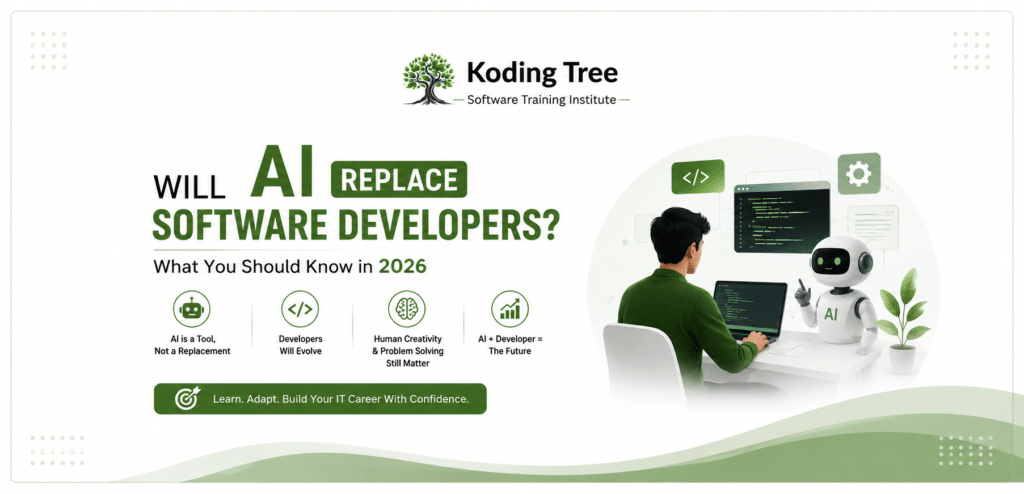
AI can write code. AI can debug errors. AI can generate test cases and even help build applications. So, does this mean software developers will soon become irrelevant? If you’re a student, fresher, career switcher, or someone planning to build an IT career, this is probably one of the biggest questions on your mind in 2026. The short answer is: No, AI is not simply going to replace software developers. But it is changing the way developers work. Artificial Intelligence and Generative AI are becoming an important part of modern software development. Developers can now use AI tools to generate code, explain errors, create documentation, write test cases, and automate repetitive tasks. This doesn’t mean that software development is disappearing. Instead, the definition of a job-ready software developer is changing. The developers of tomorrow will need more than programming knowledge. They will need problem-solving skills, practical experience, AI awareness, and the ability to understand and verify what AI produces. So, let’s understand what the future of software development could look like. Will AI Really Replace Software Developers? The idea that AI will completely replace software developers is an oversimplification. AI is excellent at handling repetitive and structured tasks. It can generate code quickly, suggest solutions, explain programming concepts, identify potential errors, and assist developers throughout the development process. But software development is much more than writing code. A real software project requires someone to understand: AI can assist with many of these activities, but human judgment and decision-making are still extremely important. The future is therefore more likely to be: AI + Developer rather than: AI vs Developer AI Is Changing the Developer’s Role For years, developers have spent significant time writing repetitive code, searching documentation, debugging common errors, and creating basic test cases. AI can now assist with many of these tasks. This gives developers more opportunities to focus on higher-value activities such as: So, AI isn’t necessarily making programming irrelevant. Instead, it is making understanding programming even more valuable. If AI generates a piece of code, someone still needs to determine whether that code is correct, secure, efficient, and suitable for the project. Why You Shouldn’t Depend Completely on AI Imagine you’re a fresher who hasn’t properly learned Java or Python. You ask an AI tool to create a complete application, and it produces hundreds of lines of code. It looks impressive. But then an interviewer asks: “Can you explain how your project works?” You don’t know. Or your application has a database issue, but you don’t understand SQL. Or an API stops working, but you don’t know how to debug it. This is where the problem begins. AI can generate an answer. You still need to understand the answer. That’s why students shouldn’t think: “AI can code, so I don’t need to learn coding.” Instead, think: “I’ll learn coding and use AI to become more productive.” Strong fundamentals allow you to use AI effectively rather than blindly depending on it. Should Freshers Still Learn Coding in 2026? Absolutely. If you’re planning an IT career, programming fundamentals remain one of the strongest foundations you can build. Technologies such as Java and Python continue to be relevant across software development, automation, data, AI, backend development, and other technology areas. But learning a programming language isn’t about memorizing syntax. You should understand concepts such as: Once you understand these fundamentals, AI becomes much more useful. You can use it to explore solutions, improve code, understand errors, and automate repetitive work—while still making the important technical decisions yourself. 5 Skills Future Software Developers Should Build If you’re planning to enter the software industry in 2026, don’t focus on learning just one technology. Build a combination of technical and professional skills. 1. Programming & Software Development Programming remains the foundation of software engineering. Whether you choose Java, Python, or another technology, focus on understanding how software actually works. For example, a Java learner can progress toward: Java → SQL → Backend → Frontend → Full Stack Development → Projects → AI-assisted development A Python learner can explore: Python → SQL → Backend/Data → Full Stack or Data Science → Projects → AI The goal shouldn’t be to simply say: “I know Java.” Instead, you should be able to say: “I can use Java to build and solve real-world problems.” 2. AI & Generative AI Skills AI is becoming a useful tool across development, testing, data, and other technology careers. You don’t necessarily need to become an AI researcher. But understanding how AI can support your work can give you an advantage. You can learn how to: The important skill isn’t simply knowing how to use an AI tool. It’s knowing when, where, and how to use it effectively. 3. Software Testing & Automation As development becomes faster, software quality becomes even more important. Modern testing can involve: This makes software testing another valuable career path for aspiring IT professionals. For someone interested in testing, a possible roadmap could be: Manual Testing → SQL → Programming → Automation → API Testing → Playwright → SDET AI may help generate test cases, but testers and developers still need to determine whether those tests cover the right scenarios. 4. Data & Analytical Thinking Modern businesses generate enormous amounts of data, creating demand for professionals who can understand and analyze it. Depending on your career goals, useful data skills can include: For students interested in Data Science, the goal shouldn’t be to simply learn multiple tools. You should learn how to take a real-world problem, work with data, identify patterns, and communicate meaningful insights. 5. Communication, Problem-Solving & Adaptability Technical knowledge alone isn’t enough. Imagine two candidates with similar programming skills. Candidate A struggles to explain their project. Candidate B can clearly explain: Candidate B can create a stronger impression during an interview. That’s why communication, critical thinking, and adaptability matter. As AI continues to evolve, technology professionals will also need to keep learning and adapting to new tools and workflows. What About Non-IT Students?
Why 100% Placement Assistance Matters: How to Choose the Right Software Training Institute in Bangalore (2026 Guide)
Confused about which software training institute in Bangalore actually delivers on 100% placement assistance? Here’s how to spot the real ones — and why Koding Tree tops the list. Bangalore didn’t become India’s Silicon Valley by accident. Every year, lakhs of students, career-switchers, and “I-did-mechanical-but-I-want-IT” folks land in this city chasing one dream: a software job that actually pays. And every single one of them types the same thing into Google at 1 AM — “best software training in Bangalore with placement.” Here’s the problem. Type that search and you’ll get 47 institutes claiming “100% placement assistance” like it’s a WhatsApp forward. Half of them mean it. The other half mean “we’ll forward your resume to a WhatsApp group and pray.” 100% placement assistance ≠ 100% placement guarantee. No legitimate institute can guarantee you a job — what they can guarantee is real effort: mock interviews, resume building, recruiter connections, and enough push to get you in front of the right people. Before you hand over your hard-earned money, check for a curriculum that matches what companies are actually hiring for, trainers with real industry experience, hands-on live projects (not just slides), a transparent placement track record, and zero hidden fees. So which software training institute in Bangalore actually delivers on all of this? Let’s talk about Koding Tree. How Koding Tree Delivers on Software Training + Placement (The Right Way) Now here’s where we stop being generic and get specific — because this is exactly where Koding Tree was built to be different. Koding Tree isn’t just another software training institute in Bangalore trying to cash in on the placement boom. It was built around one core idea: training should actually lead somewhere. Not a certificate that sits in a drawer – an actual job. Here’s how Koding Tree checks every box on the list above: ✅ Industry-Relevant Courses Koding Tree specializes in Full Stack Development, Java, and Software Testing — three of the most consistently in-demand skill sets in Bangalore’s IT job market. No outdated fluff, no filler modules. Just what recruiters are actually asking for in 2026. ✅ Real 100% Placement Assistance This isn’t a banner headline — it’s the whole point. Koding Tree pairs every student with structured placement support: mock interviews that actually simulate pressure, resume reviews that go beyond “add more keywords,” and direct exposure to companies actively hiring. The goal isn’t to hand you a certificate and wave goodbye — it’s to get you hired. ✅ Built for Everyone — Students, Professionals, and Career Switchers Whether you’re a college student trying to skip the “fresher with no experience” trap, a working professional looking to upskill, or someone pivoting careers entirely, Koding Tree’s programs are structured to meet you where you are — not where a generic syllabus assumes you are. ✅ Trainers Who’ve Actually Been in the Trenches No theory-only professors here. Koding Tree’s trainers bring real, practical software development experience into every session — because you can’t teach debugging from a textbook. ✅ A Brand That Actually Gets Bangalore’s Job Seekers Beyond the classroom, Koding Tree keeps things real — relatable content, honest conversations about the job market, and zero corporate jargon designed to confuse you into signing up. What you see is what you get. If you’re comparing software training institutes in Bangalore and placement is genuinely your top priority (as it should be), Koding Tree isn’t just an option on the list — it’s built to be the answer. Final Thoughts: Choose Training That Leads to a Job, Not Just a Certificate At the end of the day, a certificate means a lot more when there’s a real job behind it. So before you enroll anywhere, it’s okay to ask simple questions — what’s the placement support really like, who do they work with, and what happens if things take a little longer than expected. A good software training institute in Bangalore won’t mind these questions at all — they’ll walk you through it patiently. That’s really all it takes: a little research, and picking a place that treats your future seriously, not just as a sales pitch. Ready to train with an institute that actually delivers on 100% placement assistance? Get in touch with Koding Tree today. 📧 info@kodingtree.com 🌐 www.kodingtree.com 📞 94811 60201
7 Skills That Can Make You More Hireable in 2026 | Koding Tree
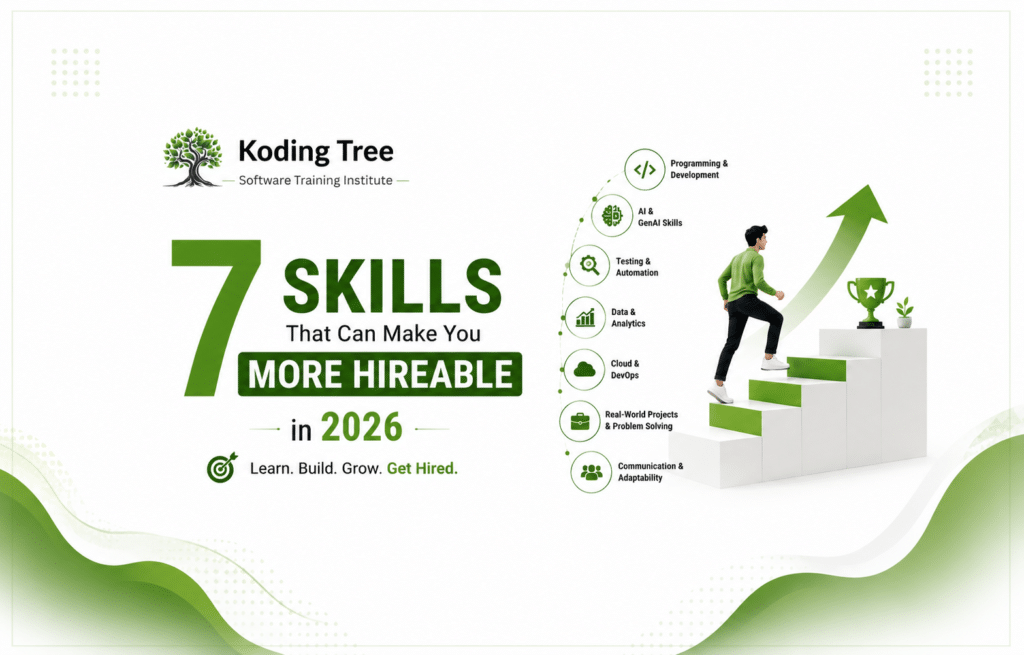
Want an IT job in 2026? Your degree is only the beginning. The technology industry is changing faster than ever. Artificial intelligence is transforming how software is developed, tested, and deployed, while companies are becoming more selective about the skills they expect from freshers and entry-level professionals. In fact, recent hiring research highlights a growing gap between how job-ready graduates believe they are and how employers perceive them. Only a small share of employers consider fresh graduates fully job-ready from day one, making practical skills and industry preparation more important than ever. So, what can help you stand out in today’s competitive IT job market? The answer isn’t simply “learn more technologies.” It’s about learning the right combination of technical, practical, and professional skills. Whether you’re a fresher, a non-IT graduate planning a career switch, or someone looking to upgrade your technology skills, here are 7 skills that can make you more hireable in 2026. 1. Programming & Software Development Programming remains one of the strongest foundations for an IT career. Languages such as Java and Python continue to appear prominently across technology hiring requirements. Current Indian tech-job data lists Python, Java, SQL, Git, cloud technologies, and related development skills among frequently requested skills. But simply knowing the syntax of a programming language isn’t enough. Employers want candidates who understand: For someone starting a software career, a structured Java Full Stack Development or Python Full Stack Development learning path can provide a strong foundation. The key takeaway: Don’t just learn to write code. Learn to build with code. 2. AI & Generative AI Skills If there’s one skill category that has changed the IT landscape dramatically, it’s Artificial Intelligence. AI is no longer something only AI engineers need to understand. Developers, testers, analysts, and other technology professionals are increasingly expected to understand how AI tools can improve their work. The 2026 Experis Tech Talent Outlook found that AI model/application development and AI literacy were among the leading skills sought by employers. But there’s an important distinction. You don’t need to become an AI researcher just because you’re entering IT. You should learn how to: The most valuable combination is not: Human vs AI It’s: Human + AI. As AI handles more routine tasks, critical thinking and the ability to evaluate AI-generated output become increasingly important. 3. Software Testing & Test Automation Software development isn’t the only route into the IT industry. Software testing and quality engineering continue to provide career opportunities for candidates who enjoy problem-solving, technology, and finding issues in applications. Modern testing has also evolved significantly. It is no longer limited to manually checking whether a button works. Today’s testing ecosystem can include: This is where SDET (Software Development Engineer in Test) skills become valuable. Automation tools such as Playwright are also becoming increasingly relevant for modern web application testing, particularly as organizations adopt faster development and continuous delivery practices. So if you are interested in QA, don’t stop at manual testing. Build toward: Testing fundamentals → Automation → Programming → API testing → Modern tools → SDET skills That combination can make your profile significantly stronger. 4. Data & Analytical Thinking Every modern business generates data. But data is useful only when professionals can understand it, analyze it, and turn it into meaningful insights. That’s why data skills remain an important part of the technology job market. Depending on the career path you choose, these skills can include: Python is particularly useful because it can connect software development with data and AI-related work. For students interested in Data Science, the goal shouldn’t be to memorize tools. The goal should be to learn how to take a real problem, work with data, identify patterns, and communicate useful conclusions. Remember: Data skills + business understanding + communication = stronger career potential. 5. Cloud & DevOps Fundamentals You may write excellent code, but do you understand what happens after the application is developed? That’s where cloud and DevOps come in. Modern software teams rely heavily on cloud platforms, automation, containers, CI/CD pipelines, monitoring, and infrastructure practices. Common technologies and concepts include: Current Indian tech hiring data continues to show strong demand for cloud and DevOps-related technologies, including AWS, Docker, Kubernetes, Terraform, Azure, and CI/CD. You don’t necessarily need to master every cloud platform. Start with the fundamentals and understand how modern applications move from development → testing → deployment → production. That broader understanding can make you more valuable as a technology professional. 6. Real-World Project & Problem-Solving Skills Here’s where many freshers struggle. They complete a course. They collect certificates. They memorize interview answers. But when an interviewer asks: “What have you actually built?” They don’t have much to show. In today’s hiring environment, employers are increasingly looking for evidence that candidates can actually apply their knowledge. Fresher hiring data highlights factors such as internships, GitHub projects, problem-solving ability, communication, and AI-tool familiarity as valuable signals. That’s why projects matter. Instead of only learning: “What is an API?” Build something that uses an API. Instead of only learning: “What is SQL?” Work with a real dataset. Instead of only learning: “What is automation testing?” Automate a real web application. Instead of only learning: “What is Java?” Build a working application using Java. Your project becomes proof of your skills. The goal should be: Learn → Practice → Build → Test → Improve → Explain That’s far more powerful than simply adding another certificate to your resume. 7. Communication, Adaptability & Continuous Learning Here’s the skill that is often underestimated. Communication. You can be technically strong, but if you can’t explain your work, communicate with your team, understand requirements, or confidently answer interview questions, your technical knowledge may not translate into a job opportunity. And in 2026, adaptability is becoming even more important. AI is changing workflows rapidly, meaning the technology you learn today may evolve tomorrow. Industry voices increasingly emphasize adaptability, critical thinking, and the ability to work effectively alongside AI. Develop these habits: The most hireable candidate
Bangalore’s IT Job Market in 2026: Skills Companies Are Actually Hiring For!
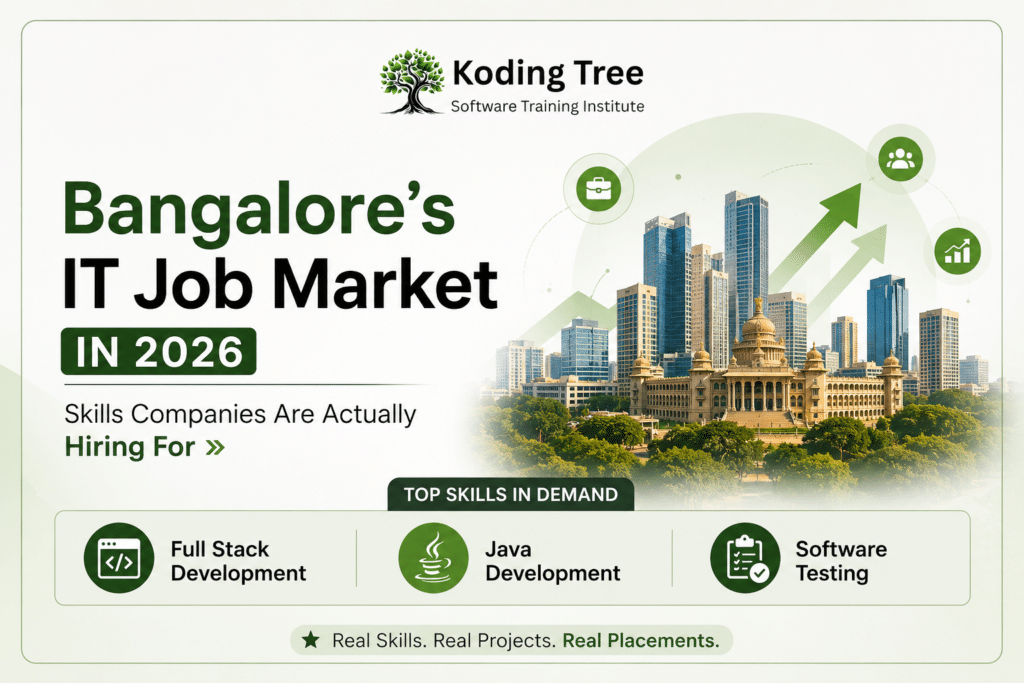
Bangalore’s IT Job Market in 2026: Skills Companies Are Actually Hiring For Bengaluru still calls itself India’s Silicon Valley, and in 2026 the title holds up. The city’s tech workforce has crossed the one million mark, the largest concentration of tech talent anywhere in the Asia-Pacific region. But if you’ve spent any time scrolling job portals lately, you already know the confusing part: everyone says “IT jobs are booming” and yet freshers still struggle to land interviews. So what’s actually going on? The honest answer is that the market isn’t short on jobs. It’s short on job-ready candidates. Bangalore’s IT hiring engine — from Global Capability Centres (GCCs) to SaaS startups to the big service companies — is expanding fast, but companies are getting far more selective about who they bring in, especially at the entry level. This post breaks down what’s really happening in Bangalore’s tech hiring scene this year, and which skills are actually opening doors, so you can plan your next move instead of guessing. Bangalore Is Still Hiring — Aggressively Despite talk of slowdowns elsewhere, Bangalore’s IT sector is in expansion mode. Global Capability Centres continue to set up shop in the city, bringing in-house tech teams for multinational banks, retailers, and product companies that used to outsource this work. Combined with steady demand from traditional IT services giants and a fast-growing startup ecosystem, the city offers one of the widest ranges of entry points into tech careers anywhere in India — whether you’re aiming for a services company, a product startup, or a GCC. Big recruiters like TCS, Infosys, Wipro, Accenture, and Capgemini continue to run large fresher hiring programs every year, alongside e-commerce and product companies like Amazon and Flipkart, which hire across tech, operations, and data roles. The takeaway: there’s no shortage of companies hiring. The real bottleneck is on the candidate side. Why “Just Knowing a Language” Doesn’t Cut It Anymore A few years ago, listing “Java” or “Python” on your resume was often enough to get you shortlisted. That’s changed. Recruiters today are combining technical screening with portfolio checks — they want to see what you’ve actually built, not just what topics you’ve studied. This shift shows up clearly in how companies evaluate freshers for full stack and Java roles. Employers increasingly care less about how much theory a candidate has memorized and more about whether they can take a feature from idea to deployment on their own. Candidates who pair core Java with Spring Boot, add a frontend framework like React, understand REST APIs and databases, and can point to two or three deployed projects tend to receive noticeably stronger offers than candidates with identical experience but only textbook knowledge. In short: employers are hiring builders, not just learners. The Three Skill Areas Driving Bangalore’s Hiring in 2026 1. Full Stack Development Full stack roles remain one of the most in-demand and most versatile entry points into tech, simply because companies would rather hire one developer who can work across the frontend, backend, and database layer than manage multiple narrow specialists. Within full stack, Java-based stacks (Spring Boot with React or Angular) are especially favoured by banks, insurance platforms, enterprises, and GCCs, where reliability and scale matter — and this segment tends to command a pay premium as experience grows. MERN stack (MongoDB, Express, React, Node) remains the most common profile overall thanks to broad startup demand, while Python-based full stack is gaining ground in startups and data-adjacent product teams. For freshers, starting packages for full stack roles in India commonly fall in the ₹3.5–6 LPA range, with product companies and GCCs offering toward the higher end for candidates who bring a strong project portfolio. 2. Java Development Reports of “Java is outdated” have been greatly exaggerated. Java continues to dominate banking systems, insurance platforms, and large enterprise software — sectors that Bangalore has no shortage of, given its concentration of GCCs and financial technology companies. Job listings for Java developer freshers remain steady across service companies and product firms alike, frequently paired with skills like Spring Boot, Hibernate, databases, and Git. The pattern recruiters look for hasn’t changed much: solid fundamentals in data structures and OOP, hands-on experience with Spring Boot, and comfort working with relational databases. Candidates who can also speak to testing and deployment tend to stand out further, since companies increasingly expect developers to own their code through to production rather than hand it off. 3. Software Testing Testing is often treated as the “backup option” by students who feel unsure about development — but that reputation doesn’t match what’s actually happening in the job market. As companies ship more complex, cloud-native applications, the demand for people who can test rigorously — manually and through automation — has only grown. Testing roles show up consistently across the same companies hiring Java and full stack developers, including large service providers building fresher pipelines specifically for QA and testing roles. For candidates who enjoy problem-solving and attention to detail but aren’t drawn to writing application code all day, testing offers a genuine, well-paying career path — not a fallback. The Bigger Shift: Hybrid Skills Are Winning Beyond individual tech stacks, one trend cuts across nearly every hiring conversation in Bangalore right now: companies want hybrid skills. That means technical ability combined with the capacity to work across teams, communicate clearly, and adapt as tools and frameworks change. Pure coding skill, without the ability to collaborate or explain your work, is increasingly treated as only half the package. This also explains why AI-adjacent skills — even at a basic, working-knowledge level — are becoming a differentiator for freshers rather than a nice-to-have. You don’t need to become a machine learning engineer, but knowing how to use AI tools to speed up development, debug faster, or write cleaner code is quickly becoming an expected baseline rather than a bonus. What This Means If You’re Starting Out (or Switching Into Tech) If there’s one pattern across Java, full stack, and