
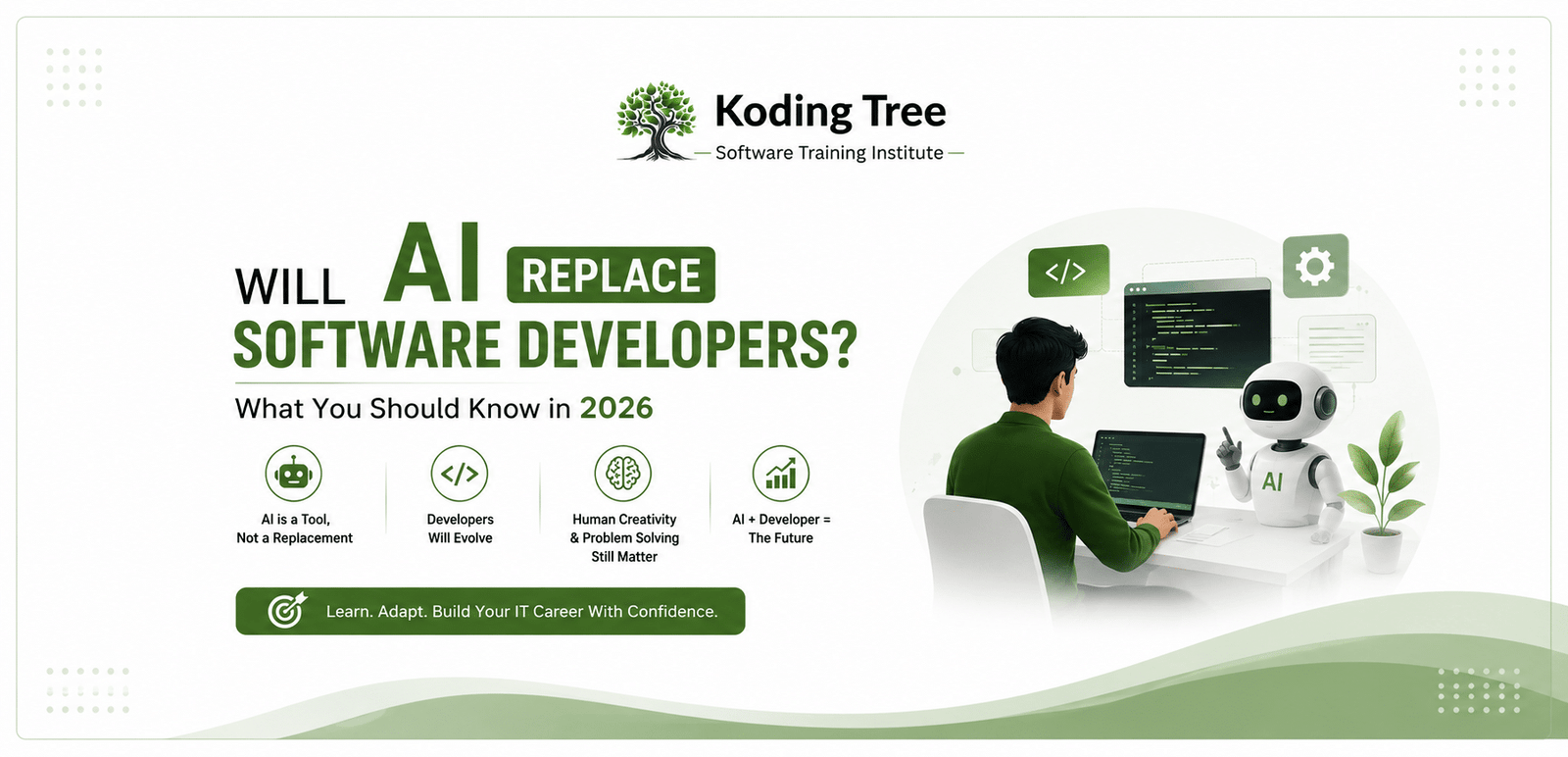
AI can write code. AI can debug errors. AI can generate test cases and even help build applications. So, does this mean software developers will soon become irrelevant?
If you’re a student, fresher, career switcher, or someone planning to build an IT career, this is probably one of the biggest questions on your mind in 2026.
The short answer is:
No, AI is not simply going to replace software developers. But it is changing the way developers work.
Artificial Intelligence and Generative AI are becoming an important part of modern software development. Developers can now use AI tools to generate code, explain errors, create documentation, write test cases, and automate repetitive tasks.
This doesn’t mean that software development is disappearing.
Instead, the definition of a job-ready software developer is changing.
The developers of tomorrow will need more than programming knowledge. They will need problem-solving skills, practical experience, AI awareness, and the ability to understand and verify what AI produces.
So, let’s understand what the future of software development could look like.
Will AI Really Replace Software Developers?
The idea that AI will completely replace software developers is an oversimplification.
AI is excellent at handling repetitive and structured tasks. It can generate code quickly, suggest solutions, explain programming concepts, identify potential errors, and assist developers throughout the development process.
But software development is much more than writing code.
A real software project requires someone to understand:
- What problem needs to be solved?
- What does the customer actually need?
- Which technology should be used?
- How should the application be designed?
- Is the code secure?
- Can the application handle more users?
- How should it be tested?
- What happens when something goes wrong?
AI can assist with many of these activities, but human judgment and decision-making are still extremely important.
The future is therefore more likely to be:
AI + Developer
rather than:
AI vs Developer
AI Is Changing the Developer’s Role
For years, developers have spent significant time writing repetitive code, searching documentation, debugging common errors, and creating basic test cases.
AI can now assist with many of these tasks.
This gives developers more opportunities to focus on higher-value activities such as:
- Designing applications
- Solving complex problems
- Understanding business requirements
- Reviewing code
- Improving application performance
- Making architectural decisions
- Testing applications
- Building better user experiences
So, AI isn’t necessarily making programming irrelevant.
Instead, it is making understanding programming even more valuable.
If AI generates a piece of code, someone still needs to determine whether that code is correct, secure, efficient, and suitable for the project.
Why You Shouldn’t Depend Completely on AI
Imagine you’re a fresher who hasn’t properly learned Java or Python.
You ask an AI tool to create a complete application, and it produces hundreds of lines of code.
It looks impressive.
But then an interviewer asks:
“Can you explain how your project works?”
You don’t know.
Or your application has a database issue, but you don’t understand SQL.
Or an API stops working, but you don’t know how to debug it.
This is where the problem begins.
AI can generate an answer. You still need to understand the answer.
That’s why students shouldn’t think:
“AI can code, so I don’t need to learn coding.”
Instead, think:
“I’ll learn coding and use AI to become more productive.”
Strong fundamentals allow you to use AI effectively rather than blindly depending on it.
Should Freshers Still Learn Coding in 2026?
Absolutely.
If you’re planning an IT career, programming fundamentals remain one of the strongest foundations you can build.
Technologies such as Java and Python continue to be relevant across software development, automation, data, AI, backend development, and other technology areas.
But learning a programming language isn’t about memorizing syntax.
You should understand concepts such as:
- Variables and data types
- Conditional statements
- Loops
- Functions
- Object-oriented programming
- Data structures
- Exception handling
- Databases
- APIs
- Debugging
- Version control
- Problem-solving
Once you understand these fundamentals, AI becomes much more useful.
You can use it to explore solutions, improve code, understand errors, and automate repetitive work—while still making the important technical decisions yourself.
5 Skills Future Software Developers Should Build
If you’re planning to enter the software industry in 2026, don’t focus on learning just one technology.
Build a combination of technical and professional skills.
1. Programming & Software Development
Programming remains the foundation of software engineering.
Whether you choose Java, Python, or another technology, focus on understanding how software actually works.
For example, a Java learner can progress toward:
Java → SQL → Backend → Frontend → Full Stack Development → Projects → AI-assisted development
A Python learner can explore:
Python → SQL → Backend/Data → Full Stack or Data Science → Projects → AI
The goal shouldn’t be to simply say:
“I know Java.”
Instead, you should be able to say:
“I can use Java to build and solve real-world problems.”
2. AI & Generative AI Skills
AI is becoming a useful tool across development, testing, data, and other technology careers.
You don’t necessarily need to become an AI researcher.
But understanding how AI can support your work can give you an advantage.
You can learn how to:
- Use AI coding assistants
- Write effective prompts
- Generate code responsibly
- Debug using AI
- Review AI-generated code
- Create test cases
- Use AI for documentation
- Identify incorrect AI outputs
The important skill isn’t simply knowing how to use an AI tool.
It’s knowing when, where, and how to use it effectively.
3. Software Testing & Automation
As development becomes faster, software quality becomes even more important.
Modern testing can involve:
- Manual testing
- Automation testing
- API testing
- SQL
- Programming
- Selenium
- Playwright
- CI/CD
- SDET practices
This makes software testing another valuable career path for aspiring IT professionals.
For someone interested in testing, a possible roadmap could be:
Manual Testing → SQL → Programming → Automation → API Testing → Playwright → SDET
AI may help generate test cases, but testers and developers still need to determine whether those tests cover the right scenarios.
4. Data & Analytical Thinking
Modern businesses generate enormous amounts of data, creating demand for professionals who can understand and analyze it.
Depending on your career goals, useful data skills can include:
- SQL
- Python
- Statistics
- Data analysis
- Data visualization
- Machine learning fundamentals
- Business intelligence
- Analytical thinking
For students interested in Data Science, the goal shouldn’t be to simply learn multiple tools.
You should learn how to take a real-world problem, work with data, identify patterns, and communicate meaningful insights.
5. Communication, Problem-Solving & Adaptability
Technical knowledge alone isn’t enough.
Imagine two candidates with similar programming skills.
Candidate A struggles to explain their project.
Candidate B can clearly explain:
- What problem the project solves
- Which technologies were used
- What challenges they faced
- How they solved those challenges
- How they tested the application
Candidate B can create a stronger impression during an interview.
That’s why communication, critical thinking, and adaptability matter.
As AI continues to evolve, technology professionals will also need to keep learning and adapting to new tools and workflows.
What About Non-IT Students?
If you’re from B.Com, BBA, B.Sc, B.A, Mechanical, Civil, Electronics, or another non-IT background, don’t assume that AI has closed the door to an IT career.
You may need to build your technical foundation from the beginning, but the journey is possible with a structured approach.
A simple roadmap is:
Choose → Learn → Practice → Build → Improve → Prepare → Apply
You don’t need to learn every technology.
Choose one career direction and develop depth.
For example:
Software Development:
Java/Python → Full Stack Development → SQL → Projects → AI tools
Software Testing:
Testing → SQL → Programming → Automation → API Testing → Playwright → SDET
Data:
Python → SQL → Statistics → Data Analysis → Machine Learning → AI
How to Choose the Right Software Training Institute
If you’re starting from scratch, learning through random tutorials can sometimes become confusing.
A structured learning environment can help you follow a clear roadmap and stay consistent.
When searching for the best software training institute in Bangalore, don’t choose an institute only because of advertisements or the number of courses it offers.
Look for:
- Experienced trainers
- Updated curriculum
- Practical training
- Real-world projects
- Industry-oriented learning
- Resume preparation
- Mock interviews
- Communication development
- Career guidance
- Placement assistance
If you’re searching for a best software training institute in Bangalore with 100% placement assistance, make sure you understand exactly what that claim means and evaluate the actual training, project exposure, interview preparation, and placement support provided.
The goal should be to become skilled and job-ready, not simply to complete a course.
How Koding Tree Helps You Prepare for an AI-Driven IT Career
At Koding Tree, the focus is on helping aspiring IT professionals develop practical and industry-oriented skills.
Koding Tree offers training in areas including:
- Java Full Stack Development
- Python Full Stack Development
- SDET & Software Testing
- Playwright Automation
- Data Science
- DevOps
- AI and GenAI-enabled technologies
Along with technical training, students can gain practical project exposure, improve communication skills, prepare resumes, participate in mock interviews, and receive career and placement assistance.
The objective is simple:
Don’t just learn technology. Learn how to apply it.
The Future Isn’t AI vs Developers. It’s AI + Developers.
So, will AI replace software developers?
AI will definitely change software development.
Some repetitive tasks will become increasingly automated. Developers may write less boilerplate code and spend more time designing, reviewing, testing, solving problems, and making technical decisions.
But software development still requires people who can understand problems, make decisions, design systems, solve unexpected issues, and take responsibility for the final product.
If you’re planning your IT career in 2026, don’t be afraid of AI.
Learn it. Understand it. Use it.
And most importantly, don’t let AI become a substitute for learning.
Let it become a tool that makes your skills more powerful.
🚀 Ready to Build Your IT Career?
Whether you’re a fresher, non-IT graduate, career switcher, or someone looking to upgrade your technical skills, the right learning path can make your journey more structured.
Koding Tree helps aspiring IT professionals develop practical skills, work on projects, prepare for interviews, and build the confidence needed to pursue opportunities in the technology industry.
Don’t wait for AI to decide the future of your career. Learn how to use AI to build it.
Learn. Build. Adapt. Get Ready for the Future with Koding Tree.
Call:- 94811 60201 | Email:- info@kodingtree.com