
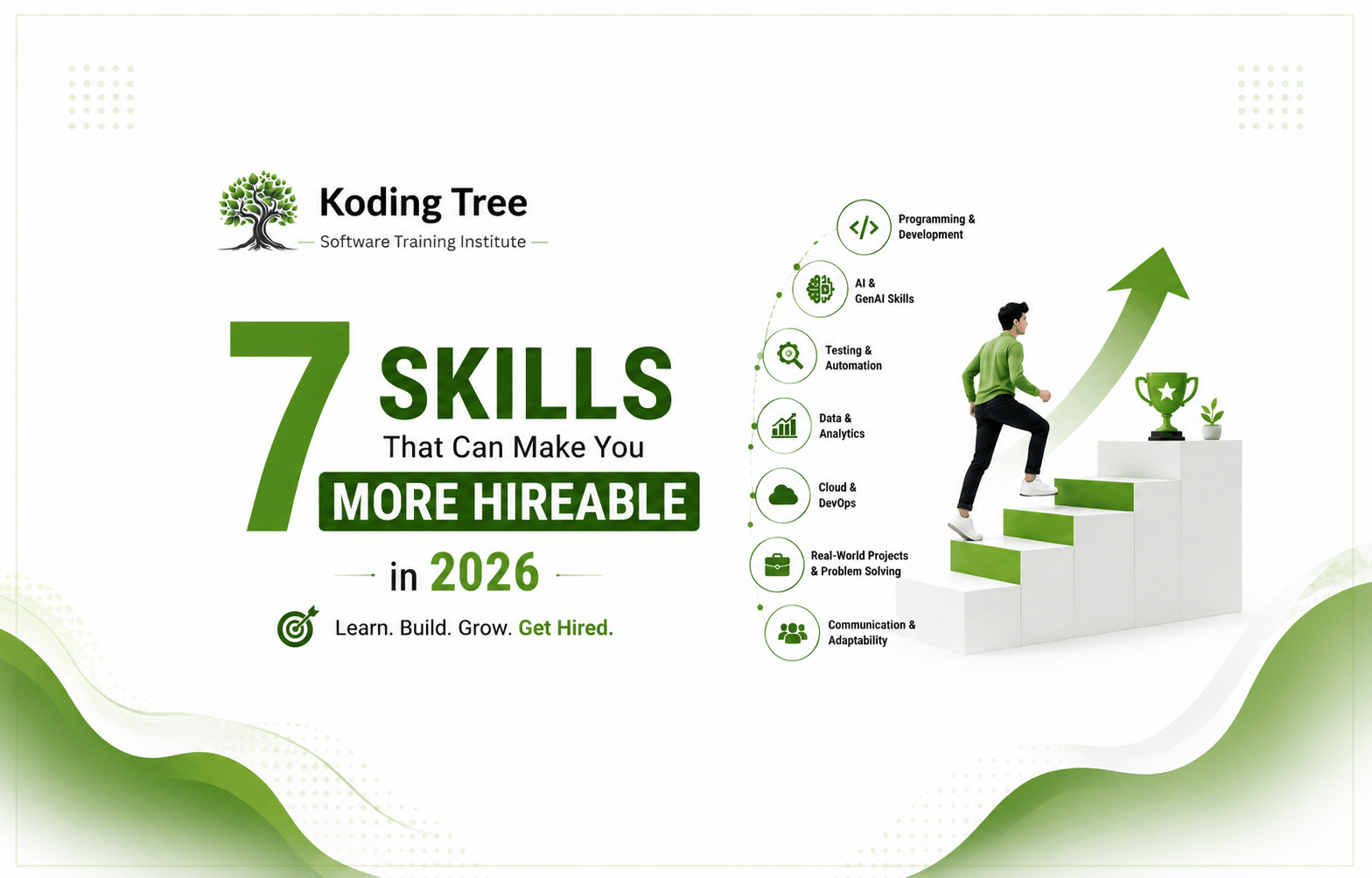
Want an IT job in 2026? Your degree is only the beginning.
The technology industry is changing faster than ever. Artificial intelligence is transforming how software is developed, tested, and deployed, while companies are becoming more selective about the skills they expect from freshers and entry-level professionals.
In fact, recent hiring research highlights a growing gap between how job-ready graduates believe they are and how employers perceive them. Only a small share of employers consider fresh graduates fully job-ready from day one, making practical skills and industry preparation more important than ever.
So, what can help you stand out in today’s competitive IT job market?
The answer isn’t simply “learn more technologies.”
It’s about learning the right combination of technical, practical, and professional skills.
Whether you’re a fresher, a non-IT graduate planning a career switch, or someone looking to upgrade your technology skills, here are 7 skills that can make you more hireable in 2026.
1. Programming & Software Development
Programming remains one of the strongest foundations for an IT career.
Languages such as Java and Python continue to appear prominently across technology hiring requirements. Current Indian tech-job data lists Python, Java, SQL, Git, cloud technologies, and related development skills among frequently requested skills.
But simply knowing the syntax of a programming language isn’t enough.
Employers want candidates who understand:
- Programming fundamentals
- Object-oriented programming
- Data structures and problem-solving
- Databases and SQL
- APIs
- Version control
- Debugging
- Application development
For someone starting a software career, a structured Java Full Stack Development or Python Full Stack Development learning path can provide a strong foundation.
The key takeaway:
Don’t just learn to write code. Learn to build with code.
2. AI & Generative AI Skills
If there’s one skill category that has changed the IT landscape dramatically, it’s Artificial Intelligence.
AI is no longer something only AI engineers need to understand. Developers, testers, analysts, and other technology professionals are increasingly expected to understand how AI tools can improve their work.
The 2026 Experis Tech Talent Outlook found that AI model/application development and AI literacy were among the leading skills sought by employers.
But there’s an important distinction.
You don’t need to become an AI researcher just because you’re entering IT.
You should learn how to:
- Use AI tools effectively
- Write useful prompts
- Generate and review code with AI
- Debug AI-generated code
- Validate AI outputs
- Automate repetitive tasks
- Understand basic GenAI concepts
The most valuable combination is not:
Human vs AI
It’s:
Human + AI.
As AI handles more routine tasks, critical thinking and the ability to evaluate AI-generated output become increasingly important.
3. Software Testing & Test Automation
Software development isn’t the only route into the IT industry.
Software testing and quality engineering continue to provide career opportunities for candidates who enjoy problem-solving, technology, and finding issues in applications.
Modern testing has also evolved significantly.
It is no longer limited to manually checking whether a button works.
Today’s testing ecosystem can include:
- Manual testing
- API testing
- Automation testing
- SQL
- Selenium
- Playwright
- CI/CD
- Programming
- Performance and quality practices
This is where SDET (Software Development Engineer in Test) skills become valuable.
Automation tools such as Playwright are also becoming increasingly relevant for modern web application testing, particularly as organizations adopt faster development and continuous delivery practices.
So if you are interested in QA, don’t stop at manual testing.
Build toward:
Testing fundamentals → Automation → Programming → API testing → Modern tools → SDET skills
That combination can make your profile significantly stronger.
4. Data & Analytical Thinking
Every modern business generates data.
But data is useful only when professionals can understand it, analyze it, and turn it into meaningful insights.
That’s why data skills remain an important part of the technology job market.
Depending on the career path you choose, these skills can include:
- SQL
- Python
- Excel
- Statistics
- Data visualization
- Data cleaning
- Machine learning fundamentals
- Business intelligence
- Analytical thinking
Python is particularly useful because it can connect software development with data and AI-related work.
For students interested in Data Science, the goal shouldn’t be to memorize tools.
The goal should be to learn how to take a real problem, work with data, identify patterns, and communicate useful conclusions.
Remember:
Data skills + business understanding + communication = stronger career potential.
5. Cloud & DevOps Fundamentals
You may write excellent code, but do you understand what happens after the application is developed?
That’s where cloud and DevOps come in.
Modern software teams rely heavily on cloud platforms, automation, containers, CI/CD pipelines, monitoring, and infrastructure practices.
Common technologies and concepts include:
- AWS
- Azure
- Docker
- Kubernetes
- Linux
- Git
- CI/CD
- Infrastructure automation
- Cloud fundamentals
Current Indian tech hiring data continues to show strong demand for cloud and DevOps-related technologies, including AWS, Docker, Kubernetes, Terraform, Azure, and CI/CD.
You don’t necessarily need to master every cloud platform.
Start with the fundamentals and understand how modern applications move from development → testing → deployment → production.
That broader understanding can make you more valuable as a technology professional.
6. Real-World Project & Problem-Solving Skills
Here’s where many freshers struggle.
They complete a course.
They collect certificates.
They memorize interview answers.
But when an interviewer asks:
“What have you actually built?”
They don’t have much to show.
In today’s hiring environment, employers are increasingly looking for evidence that candidates can actually apply their knowledge. Fresher hiring data highlights factors such as internships, GitHub projects, problem-solving ability, communication, and AI-tool familiarity as valuable signals.
That’s why projects matter.
Instead of only learning:
“What is an API?”
Build something that uses an API.
Instead of only learning:
“What is SQL?”
Work with a real dataset.
Instead of only learning:
“What is automation testing?”
Automate a real web application.
Instead of only learning:
“What is Java?”
Build a working application using Java.
Your project becomes proof of your skills.
The goal should be:
Learn → Practice → Build → Test → Improve → Explain
That’s far more powerful than simply adding another certificate to your resume.
7. Communication, Adaptability & Continuous Learning
Here’s the skill that is often underestimated.
Communication.
You can be technically strong, but if you can’t explain your work, communicate with your team, understand requirements, or confidently answer interview questions, your technical knowledge may not translate into a job opportunity.
And in 2026, adaptability is becoming even more important.
AI is changing workflows rapidly, meaning the technology you learn today may evolve tomorrow. Industry voices increasingly emphasize adaptability, critical thinking, and the ability to work effectively alongside AI.
Develop these habits:
- Ask better questions
- Explain technical concepts clearly
- Participate in discussions
- Practice presentations
- Take mock interviews
- Stay updated with technology
- Learn continuously
- Be willing to adapt
The most hireable candidate isn’t the person who knows everything.
It’s the person who can learn, adapt, solve problems, and contribute.
So, What Skills Should You Learn First?
You don’t need to learn all seven skills at the same time.
Your career path should determine your learning roadmap.
Interested in Software Development?
Start with:
Java/Python → SQL → Full Stack Development → Projects → Git → AI-assisted development
Interested in Software Testing?
Consider:
Manual Testing → SQL → Programming → Automation → API Testing → Playwright → SDET
Interested in Data?
Consider:
Python → SQL → Statistics → Data Analysis → Visualization → Machine Learning → AI
Interested in DevOps?
Consider:
Linux → Git → Cloud → Docker → CI/CD → Kubernetes → Infrastructure
The important thing is to develop depth in one career path rather than collecting surface-level knowledge across ten different technologies.
What About Non-IT Graduates?
If you’re from B.Com, BBA, B.Sc, B.A, Mechanical, Civil, Electronics, or another non-IT background, don’t assume that your degree automatically prevents you from entering technology.
The path may require additional technical preparation, but the fundamentals remain learnable.
Your focus should be:
Choose a career path → Learn the fundamentals → Practice consistently → Build projects → Develop communication skills → Prepare for interviews → Apply strategically
The current hiring landscape also shows examples of employers expanding talent pools beyond traditional STEM backgrounds, reinforcing the importance of skills and adaptability alongside academic qualifications.
How Koding Tree Can Help You Become Job-Ready
Learning from random videos and tutorials can give you information.
But becoming job-ready requires structure, practice, guidance, and consistent preparation.
At Koding Tree, we focus on helping aspiring IT professionals develop practical, industry-oriented skills through structured training.
Our learning paths include areas such as:
- Java Full Stack Development
- Python Full Stack Development
- SDET & Software Testing
- Playwright Automation
- Data Science
- DevOps
- AI and GenAI-enabled technologies
Beyond technical training, students can work on practical projects, improve communication, prepare their resumes, participate in mock interviews, and develop the confidence needed for the hiring process.
If you’re searching for a software training institute in Bangalore that focuses on practical learning and career preparation, choosing an institute based on hands-on training, trainer experience, project exposure, and placement support can make a significant difference.
Final Thoughts: Don’t Just Become Job-Ready. Become Future-Ready.
The IT industry in 2026 isn’t asking candidates to know everything.
It’s looking for people who can build, test, analyze, adapt, communicate, and learn.
Programming gives you a foundation.
AI helps you work smarter.
Testing helps you build quality.
Data helps you make better decisions.
Cloud and DevOps help you understand modern deployment.
Projects prove what you can actually do.
Communication and adaptability help you succeed beyond the interview.
So don’t ask:
“Which course will guarantee me a job?”
Ask:
“Which skills can help me become valuable to an employer?”
That’s the mindset that can change your career.
🚀 Ready to Build Your IT Career?
Whether you’re a fresher, a non-IT graduate, or someone looking to switch careers, Koding Tree can help you choose a suitable technology path and develop practical skills for today’s IT industry.
Learn the right skills. Build real projects. Prepare with confidence. Take the next step toward your IT career with Koding Tree.
Your degree may introduce you. Your skills can make you stand out.
Connect With Us And Start Your IT Career With Us
Call:- 94811 60201 | Email:- info@kodingtree.com